Web Scraping 1: Combine multiple tables from one page in Power BI and Power Query

This is a step-by-step description of how to combine multiple tables from one webpage into one table with categories as output. You can also apply this technique to combine tables from other sources as well (like from folder method for example or multiple different webpages (see this article)).

Sometimes the page you want to scrape has multiple tables like here:
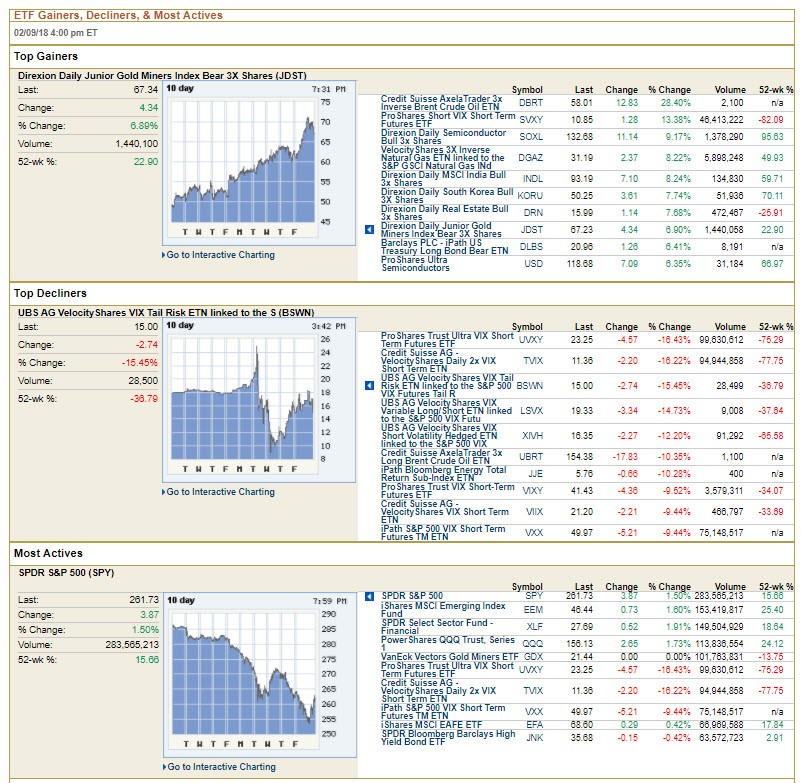
0 – Combine multiple tables into one: Input

And you want to combine them into 1 with a Category-column like so:
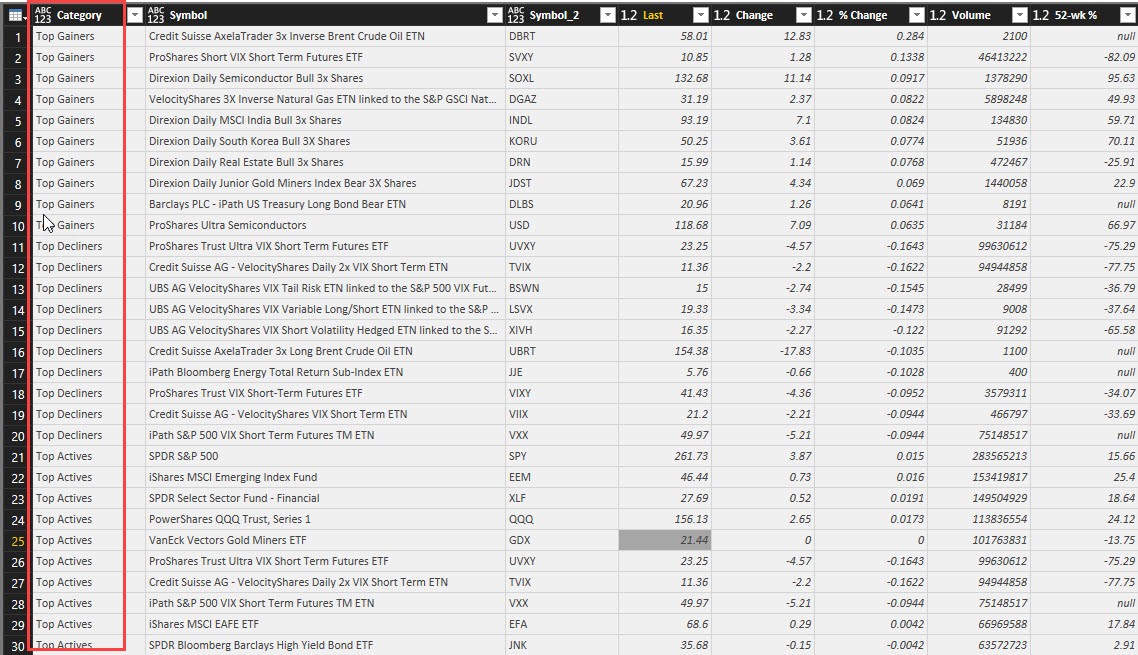
1 – Combine multiple tables into one: Result

Overview

I will present 2 methods here:

  1. Append-method: This is the obvious one and is fast for just a few tables.
  2. Add-Column-method: A bit more complicated but will be faster for a large number of tables and is also suitable for a dynamic number of tables.

You will also find 2 options at the end of this article:

  1. Use custom functions for multi-step table transformations
  2. Use dynamic filters to select the desired tables


Append method

Read more

List.SelectPositions in Power BI and Power Query

With this new custom function “List.SelectPositions” you can easily select items from a list by just passing a list of their positions within it as the parameter.

What it does

Say you have a list with numbers {1..5} and want to select the 1st, 4th and 5th element from it. Then you can pass these positions to the function as another list: {0, 3, 4}.

ListSelectPositions({1..5}, {0, 3, 4}) will return: {1,4,5}

You see that I’ve decided to follow the zero-based counting principle here, that you find throughout M in the query editor. If you don’t like that, you can use the optional 3rd parameter to let it start to count from 1 instead:

ListSelectPositions({1..5}, {1, 4, 5}, 1) will return {1, 4, 5}

But if you have entered positions that don’t exist, the function will return an error in their positions by default:

ListSelectPositions({1..5}, {1, 4, 5}) will return {2, 5, Error}

because there is no 6th element (you’ve omitted the 3rd parameter that allows you to start counting with 1).

But you can change this behaviour as well through the last optional 4th parameter: Setting it to 0 will fill the missing positions with null like this:

ListSelectPositions({1..5}, {1, 4, 5}, null, 0) will return {2, 5, null}

and setting it to 1 will eliminate it and shorten the list like this:

ListSelectPositions({1..5}, {1, 4, 5}, null, 1) will return {2, 5}

These additional error-handling-options of the 4th parameters are useful for dealing with badly formatted data and if you want to learn more about it, just let me know in the comments so that I can prioritize it.

Function code

Read more

Table.Group: Exploring the 5th element in Power BI and Power Query

In this post I’ll show you the magic stuff you can do with the 5th parameter (the optional comparer function) of the Table.Group M-function in Power BI and Power Query:

Table.Group parameters

  1. table as table,
  2. key as any,
  3. aggregatedColumns as list,
  4. optional groupKind as nullable number,
  5. optional comparer as nullable function

If you’re not familiar with the 4th parameter (groupKind) already, I strongly recommend to read Chris Webb’s article, as we will build on its knowledge here.

Another aspect worth mentioning for the modus in GroupKind.local is the performance aspect: It runs MUCH faster for large datasets than the default-setting. So if you are sure that your data will always be sorted accordingly, you can speed up your grouping-operations considerably. That means: Your data has to be sorted correctly by default. At least for my tests, you would loose the performance-gain once you’d sort your table by an explicit step before.

You can find an overview of comparer functions here.

Case insensitive grouping

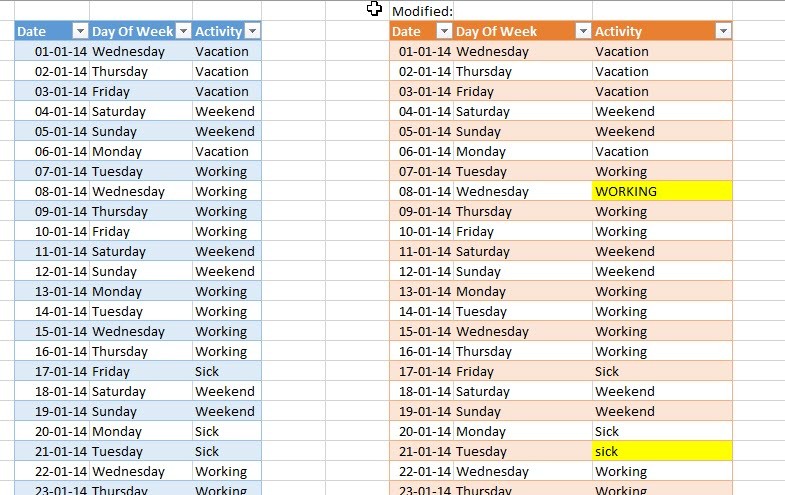
Imagine there was a twist in Chris’ dataset and it would look like so:

Table.Group – Modified Source Data

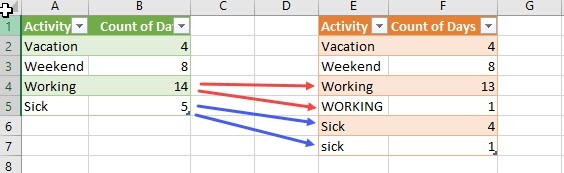
We would probably not be happy with these results then:

Table.Group Problem with Case Sensitivity

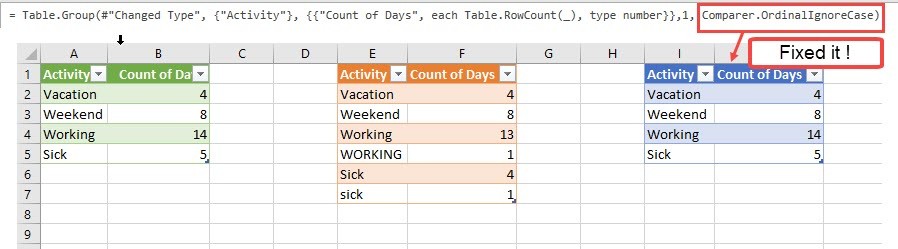
Because M is by default case sensitive, we get more groups than we want. Let’s try Comparer.OrdinalIgnoreCase to the rescue then:

Pretty neat, isn’t it 😉  (You can use that comparer in other functions as well, see here for text- and list operations)

Something like this was what I’ve showed Huang Caiguang the other day, who asked me what the 5th parameter of this function was about (or so I understood). He then sent me a link to one of his articles, which demanded a good 2 hours for me to digest and understand: We can also use custom functions to create all different sorts of grouping behaviours here. These are my 2 favourites:

Read more

Import text from pdf files in Power BI

While Power BI will soon provide functions to import tables from pdf-files, there might be occasions when you actually need to import text from pdf files (in unstructured form). With a little help from R in Power BI you can do exactly that. (And don’t worry: No need to learn R here: The necessary R-code is already included in my function … Read more

Remove repeating characters from a string in Power BI and Power Query

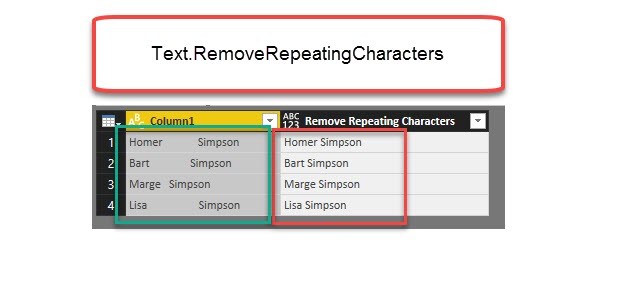
Repeating spaces often cause problems when cleaning up your data. My new function “Text.RemoveRepeatingCharacters” can come to the rescue here. Imagine you have a table like this: Challenge To further work with this data, it would often be best if there was just one space between the words and not many. The following function will do this for you: … Read more

Date.DatesBetween to retrieve dates between 2 dates in Power BI and Power Query

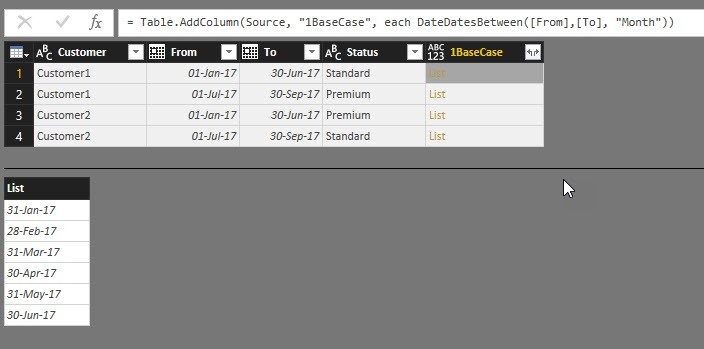
Today I’m sharing a handy function with you that allows you to retrieve all or just a couple of dates between 2 given dates: Date.DatesBetween.

Usage

This function takes 3 parameters:

  1. From- or Start-date
  2. To- or End-date
  3. A selection of ONE of these intervals: Year, Quarter, Month, Week or Day

All dates will be created at the end of the chosen interval: So if you want to analyse events with a duration for example, where you want to transform your data to show one day per (monthly) event, this function generates month-end-dates for every month within the timespan. Please not that if the To-/End-date is within a month, the last element of the list will NOT be that day, but the day of the end of that month.

The default-value for the 3rd parameter is “Day”, so if you omit the specification, the function will return a list of all days in between.

Read more