Your Oracle data import in Power BI and Power Query is slow?

If you’re using the native Oracle connector in Power Query, you will probably experience a very slow import performance. Thanks to Tristan Malherbe for recommending to use the OleDB-connector in Power Query instead. This speeds up import enormously. Just have in mind, that this method might prevent query folding, so it is mostly suitable for scenarios where you have to pull the full tables anyway.

How to create the connection string

If you’re using the OleDb.DataSource connector instead, you have to pass a connection string as the first parameter and an optional query record as the second parameter. To speed it up even more, you should use a FetchSize parameter in the connection string. For me, this didn’t work when I pasted it into the popup-window. So I had to manually add it in the query editor:

OleDB connection to an Oracle database

The “:1521” in the connection string is the port number, which is usually 1521 for Oracle databases.
Read more

Performance tip to speed up slow pivot operations in Power Query and Power BI

Pivot operations in are a very handy feature in  Power Query but they can slow down refresh performance. So with some bittersweet pleasure I can tell that I found a trick to speed them up. The sweetness comes from the fact that the performance improvement is very significant. But the bitterness comes from the fact that I could have used this for almost 4 years now, but was too blind to realize at the time when I first worked with the code.

Trick to speed up a slow pivot table

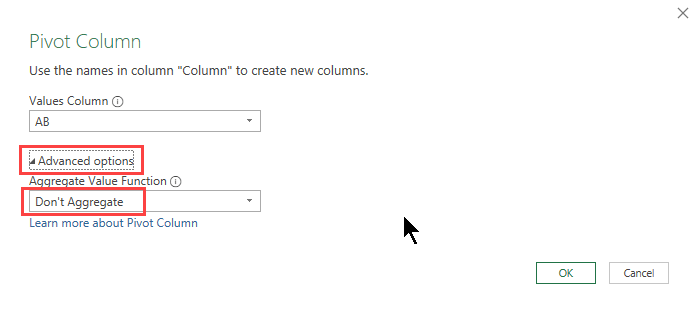
This might not work everywhere, but for my tests, it worked really well: Don’t use an aggregation function when you want fast pivoting:

slow pivot
Don’t aggregate when you want a fast pivot in Power Query

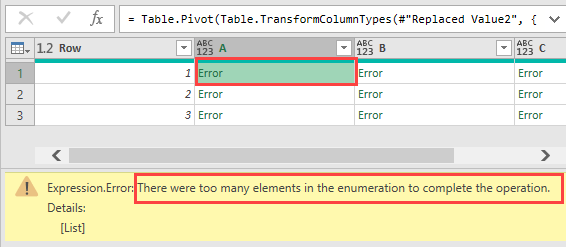
But if your data isn’t aggregated on the row- & column values already, you’ll get this error message:

Error when the values are not adequately aggregated

So to make this work, you have to aggregate the values on the axis’ values before.

Let’s walk through the steps:

Walkthrough

Read more

Performance tip for aggregations after joins in Power Query and Power BI

This article was edited on 2nd Nov 2019. JoinKind.Local has been removed to avoid problems with merges on tables with primary keys:

In this article you’ll learn how to speed up the aggregation of joined/merged tables by orders of magnitude (I recorded up to 30 times faster execution times). This method works for merges where both table have multiple rows for each keys. If one of your tables has a primary key, the method Chris Webb describes here works just as good: Chris Webb’s article on how to improve performance on aggregations after joins using primary keys .

You can follow along the different methods in this file:  PerformanceAggregationsAfterMerges1_Upload.zip

Background

When you join a table to another table in Power Query, the UI gives you the option to either expand the columns (default) or aggregate the contents of the joint tables. That’s useful if multiple rows are returned for the rows of the table that has been joined to (left table):

Read more

Memory efficient clustered running total in Power BI

Today I want to share a scenario where a running total calculation in the query editor saved a model that run out of memory when done with DAX:

Problem

The model couldn’t be refreshed and returned out of memory error with a calculated column in the fact table of over 20 Mio rows (from a csv-file). A running total should be calculated for each “JourneyID”, of which there were over 1 Mio in the table itself. This rose memory consumption during refresh by over 300 % – until it finally errored out:

Besetzung =
CALCULATE (
    SUM ( Fact[Entries] )
– SUM ( Fact[Exits] );
    FILTER (
        ALLEXCEPT ( Fact; Fact[JourneyID] );
Fact[StopId]
<= EARLIER ( Fact[StopId] )
    )
)

Solution

Read more

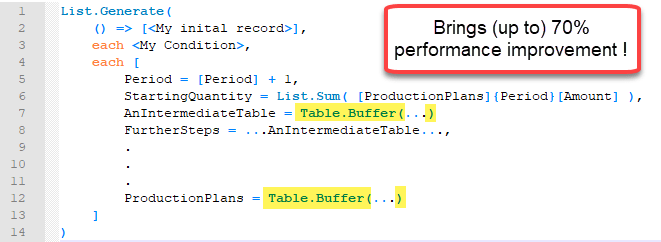
Performance tip for List.Generate (1): Buffer your tables in Power BI and Power Query

Lately I was working on a fairly advanced allocation algorithm on large data which forced me to search for different tricks to improve performance than those that you can find on my site here already. Background I was using List.Generate to check for every month in my table, if there was enough free capacity on … Read more

Improve import of Excel sheets with empty rows and columns in Power Query and Power BI

When you import Excel sheets who have empty leading or trailing columns and rows (showing null-values), you can substantially improve the complexity and speed of your import process with a simple trick: Remove the reasons for the empty trailing rows and columns 😉 Background Usually, when you import data from an Excel sheet, Power Query … Read more