Stretching and Compressing Time Series with Power Query and Power BI

The good folks from SumProduct have published a challenge for Excel that I find worth doing in Power Query instead:

The Challenge

Stretching or compressing a forecast so that the proportion of the original series will be maintained:

The Function

This is not so easy mathematically (as the solution-blogpost explains in detail), so the code for the function isn’t short as well:

Read more

RegEx in Power BI and Power Query in Excel with Java Script

From time to time Huang Caiguang sends me some geeky M-code that turns out to be very useful (like this for example). Today it’s utilizing java script code for RegEx (regular expressions): The Web.Page function can execute JS code and you can pass strings from you M-environment to it with simple string concatenation. So escape … Read more

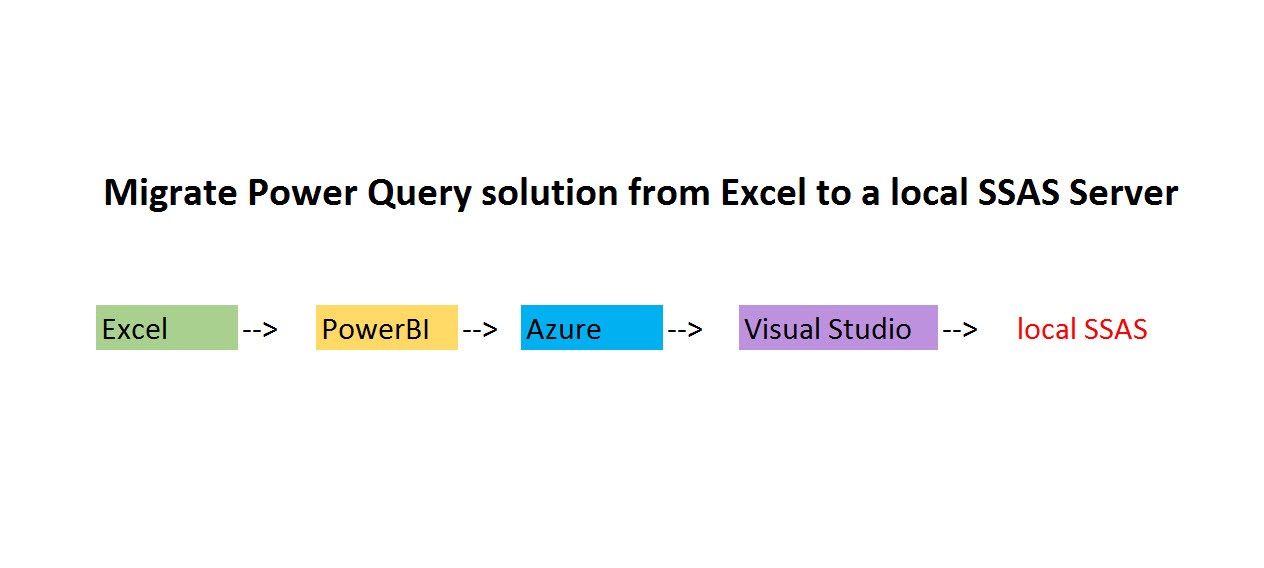
Migrate a Power Query or Power BI file to a local SSAS instance

Edit: This feature has been deprecated since 1st March 2019 unfortunately: https://azure.microsoft.com/en-us/updates/azure-analysis-services-web-designer-to-be-discontinued/ – Microsoft is working on replacement of the functionality to move pbix-files to SSAS-instances, but no solution yet. In Visual Studio there is a wizard to migrate an Excel Power Pivot model to a SSAS model. But this will not bring over the M-queries … Read more

Web Scraping 2: Scrape multiple pages at once and refresh in Power BI service

In the first post of this series I’ve explained how to simultaneously load and combine multiple (similar structured) tables from ONE PAGE. This post handles the other direction, how to combine tables from DIFFERENT PAGES into one (or to scrape multiple webpages at once). Overview Theoretically, this is quite a simple process: Create a query that fetches and transforms … Read more

A generic SWITCH-function for the query editor in Power BI and Power Query

Although you can easily replicate the DAX SWITCH-function via list-, table- or record functions in M, I thought it would be convenient for many newbies to have a comfortable M-SWITCH-function that uses (almost) the same syntax than its DAX-equivalent:

SWITCH (
[Month],
    1“January”,
    2“February”,
    3“March”,
    4“April”,
    5“May”,
    6“June”,
    7“July”,
    8“August”,
    9“September”,
    10“October”,
    11“November”,
    12“December”,
    “Unknown month number”
)
DAX Formatter by SQLBI

The DAX-SWITCH-function will retrieve the content of its first argument (expression) ([Month]) and check it against he first parameters of the following pairs (value). If there is a match, the second parameter of the pairs (result, here: month name) is returned and if there is no match, “Unknown month number” will be returned.

How it works

The syntax for the M-function looks like so:

Read more

Web Scraping 1: Combine multiple tables from one page in Power BI and Power Query

This is a step-by-step description of how to combine multiple tables from one webpage into one table with categories as output. You can also apply this technique to combine tables from other sources as well (like from folder method for example or multiple different webpages (see this article)).

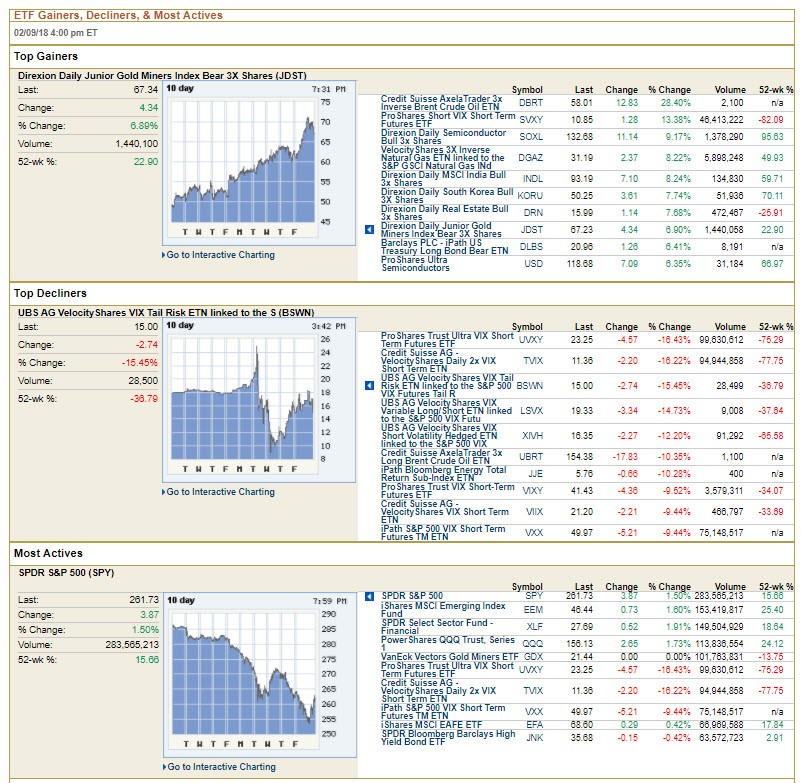
Sometimes the page you want to scrape has multiple tables like here:

0 – Combine multiple tables into one: Input

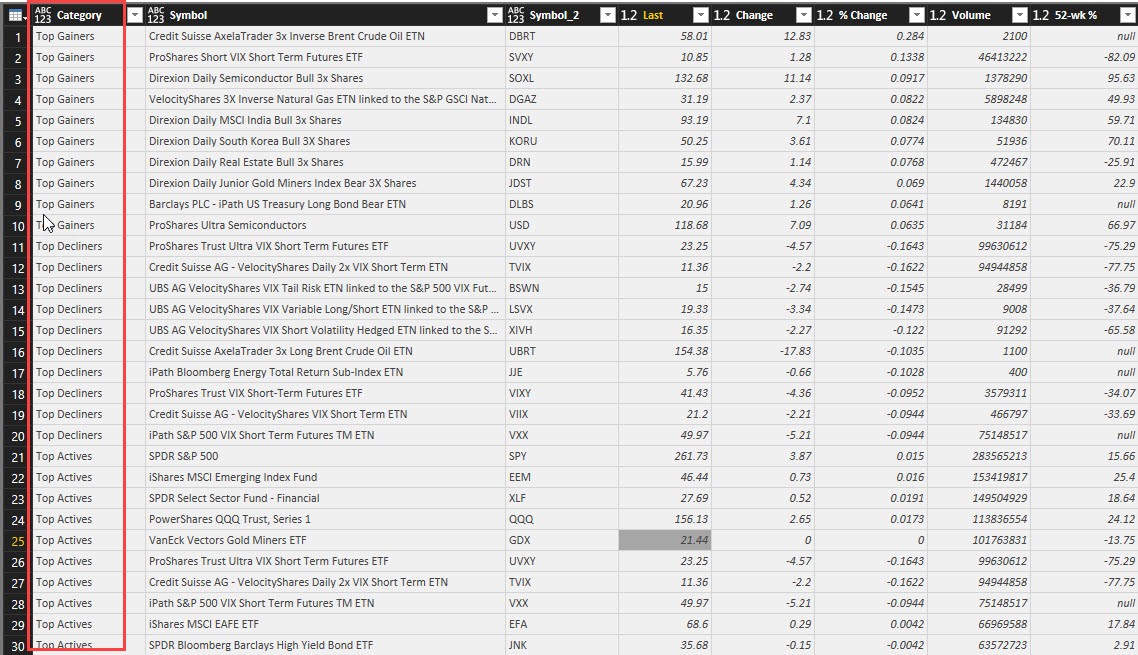
And you want to combine them into 1 with a Category-column like so:

1 – Combine multiple tables into one: Result

Overview

I will present 2 methods here:

  1. Append-method: This is the obvious one and is fast for just a few tables.
  2. Add-Column-method: A bit more complicated but will be faster for a large number of tables and is also suitable for a dynamic number of tables.

You will also find 2 options at the end of this article:

  1. Use custom functions for multi-step table transformations
  2. Use dynamic filters to select the desired tables


Append method

Read more