Should we pipe M?

“Just because you could doesn’t mean you should”… So I’m asking the Power Query and M fans & experts here if we “should” pipe M: Background: With M you can nest your expressions like in Excel to group commands that belong together. But this has some disadvantages like: Reading: the execution order of the functions doesn’t match … Read more

New M-function: Table.TransformColumnTypesToFirstRowsTypes for PowerBI and PowerQuery

The following function automatically transforms all columns to the types that have been detected in the cells of its first row. Provided they come as: Number, date or text (but you can add additional type conversions if you need them.). It also has some rough edges: If the first value is empty, the column will … Read more

How to expand a column that cannot be expanded in Power BI and Power Query in Excel

Especially when working with JSON-data, you might end up with a column that has elements of mixed types in it. The expand column – arrows will be missing, but some elements still need to be expanded, like here: But there is an easy way to fix it: Transform to expandable column Table.TransformColumns(Source, {{“Column1”, each if Value.Is(_, type list) … Read more

Table.TransformColumns – alternative in PowerBI and PowerQuery in Excel

This article shows a trick for a little problem that annoyed me for quite some time: How to get Table.TransformColumns transforming the values of a column with a reference to a value (from the same row) of another column?

1 Replace text by a value from another column

So instead of adding a new column where the “*” is replaced by the value from column “WhildcardValue”, I just want to perform the replacement-operation in the original “Text”-column, so that I don’t have to rename and delete the other columns later:

So far, I always ended up fighting with Table.TransformColumns-function and got quite frustrated because I couldn’t find a way to reference the (row-) value of the other column. As it turns out, I was fighting the wrong target here, because Table.ReplaceValue is actually the saviour for this challenge:

1.1 Check column “Text” -> Transform -> Replace Values
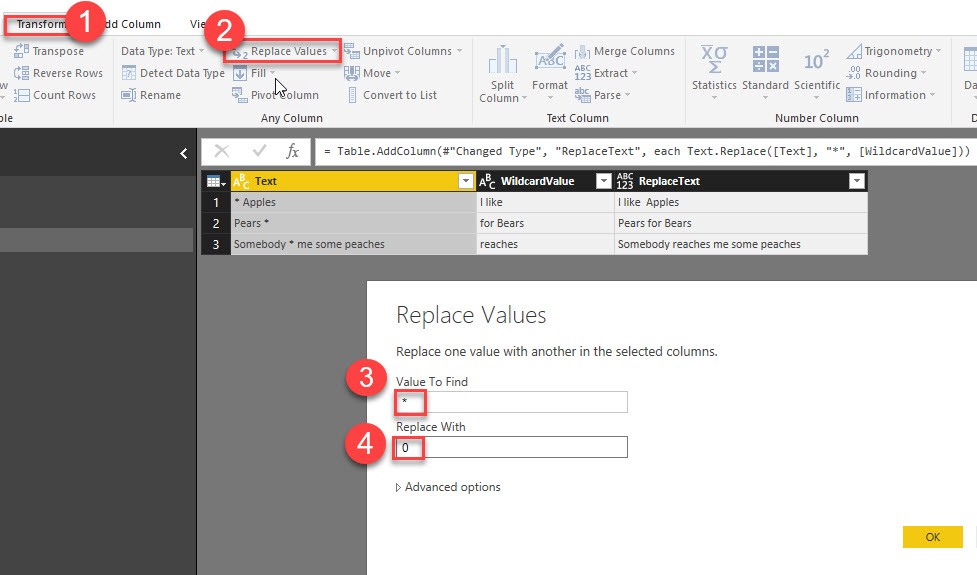
So in (4) we just filled in a dummy-value, which we’re going to replace with a reference to the desired column: “each [WildcardValue]” like this:
Read more

SQL-query folding bug still alive and sucking in PowerBI and PowerQuery in Excel

Edit: There is currently no interest at Microsoft to change the current behaviour: http://community.powerbi.com/t5/Issues/Bug-Query-folding-not-working-with-non-SQL-datasource/idi-p/225100#M11611 . I found that this workaround works also pretty well (faster in most cases), as long as your filter-tables are not too long: http://community.powerbi.com/t5/Desktop/Parameterized-SQL-Query-with-query-folding/td-p/171503 Are your SQL queries that filter with a non-SQL-table slow in PowerBI and PowerQuery in Excel? Then … Read more

Non-linear Break-Even Analysis in PowerBI

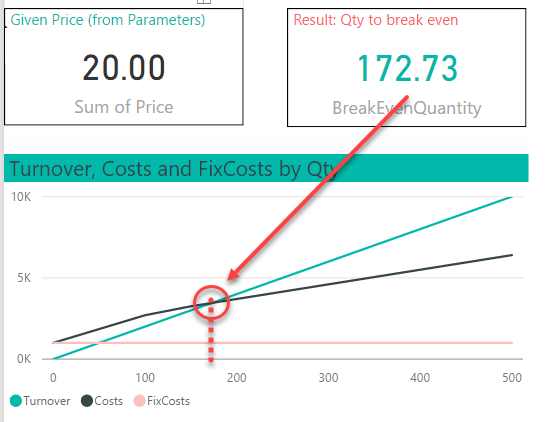
A break-even analysis tells you at which value of the parameter in question your profit-calculation will turn positive (link). Here we need to sell at least 173 at a given price of 20 before we’ve recovered all our costs:

If your variable costs are constant, you can solve it by this formula:

BreakEvenQuantity = Total Fixed Costs / (Unit Sale Price - Unit Variable Costs)

You’ll find tons of examples on how to do this in Excel like here .

Non-linear cost structure

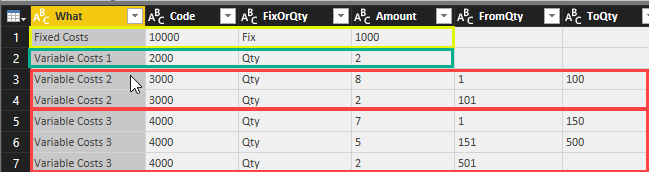
But in real life, the variable costs often depend on certain quantities as you get discounts for purchasing large amounts. The following table shows a cost structure with fix costs in row 1. The 3rd column “FixOrQty” indicates if the cost item is fix or dependent on the quantity (Qty). The 2nd row contains a variable cost that is constant with 2 for all quantities. Row 3&4 show a variable cost of 8 for quantities up to 100 and if you purchase more than 100 the costs will be lowered to 2 for all additional quantities. Row 5-7 have a similar structure, but with 3 quantity ranges:

 Solve with goal-seek algorithm

Read more