
Import Measures from different Tabular Models using DAX Editor

Marco Russo has created a great tool for SSAS tabular that lets you edit measure definitions (which you should read here first if you haven’t done yet).

In this article I’ll show you how you can use it to import multiple measures from different tabular models into your current model.

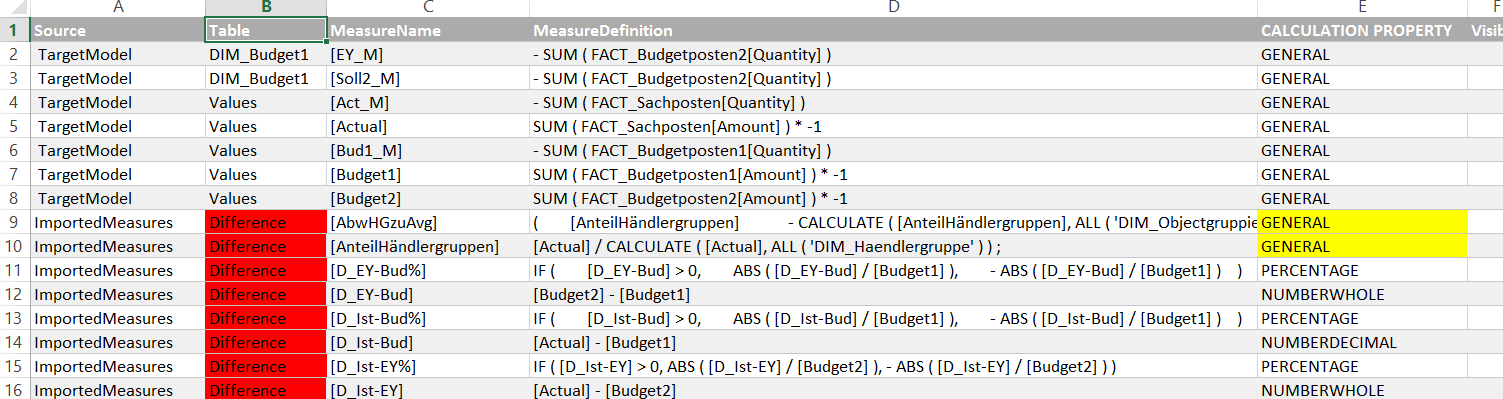
The way the DAX-editor works is that it exports the existing measures from your model as a text file and imports them back after you’ve done your transformations. My technique will add the measures from the other model automatically to the existing measures so that both can be loaded back into your current model. In addition to that, you will have a UI with a process that guides you through the necessary steps that come with a task like that, which are:

  • select only those measures that you actually need
  • check references to existing measures and columns from the import model and manage their handling
  • allocate the tables into which these measures are going to be imported

This will all be done in a Power Query-powered Excel workbook that you can download here:   DaxEditorEditor_Final2.xlsm

These are the steps:

Read more

Incremental load in PowerBI

Edit 2017-Jan-13: You’ll find a more recent version that doesn’t use hacks for incremental load here (but that also won’t work in the service): http://www.thebiccountant.com/2017/01/11/incremental-load-in-powerbi-using-dax-union/

If you want to perform incremental load of your data in PowerBI, you should vote for it here.

Please vote before you read on to see which hacky workaround to use until this is implemented.

This workaround is a compromise that’s mainly suited for use cases like:
– performing extensive transformations on imported data only once
– saving data in the model that will not be available at the source later on (like many web-imports)

It works on the principle of self-referencing-queries like I’ve described here in combination with the hack of your current PBI-datamodel which I’ve described here (that’s fully automated now). So it will just work in the Desktop version and not in the service (so no scheduled refresh possible) !!.

So the data that should “sit in the model” and just be merged with new incoming data will actually be imported into the model again. Just not from it’s original source, but instead from itself. As this is often slower than to import from the original source, you will have to look closely into your specific need and decide if this makes sense for you.

These are the steps to perform:

1) Create 1st query that imports and transforms the first chunk of data that shall not be refreshed afterwards and load it to the data model
2) Go back to the query designer and create a 2nd query that re-imports 1st query using the function below
3) Create a 3rd query that appends query2 to query1 and load it to the model
4) Go back to the query designer and choose 3d query to implement a filter or remove-duplicates step that avoids importing data that has already been imported
5) Change the source in the 2nd query from 1st to 3rd query (as you now want to reference everything that has been imported so far).
6) Disable load of the first two queries

Read more

Speed up the PowerBI and Power Query design process

When querying large databases with Power BI or Power Query, the design of the query itself sometimes causes long waiting periods because of background loading activities. In order to speed up this process, I’m adding a filter in my tables as one of the first steps, which I can toggle on or off using a central … Read more