Your Oracle data import in Power BI and Power Query is slow?

If you’re using the native Oracle connector in Power Query, you will probably experience a very slow import performance. Thanks to Tristan Malherbe for recommending to use the OleDB-connector in Power Query instead. This speeds up import enormously. Just have in mind, that this method might prevent query folding, so it is mostly suitable for scenarios where you have to pull the full tables anyway.

How to create the connection string

If you’re using the OleDb.DataSource connector instead, you have to pass a connection string as the first parameter and an optional query record as the second parameter. To speed it up even more, you should use a FetchSize parameter in the connection string. For me, this didn’t work when I pasted it into the popup-window. So I had to manually add it in the query editor:

OleDB connection to an Oracle database

The “:1521” in the connection string is the port number, which is usually 1521 for Oracle databases.
Read more

Convert DateTime to ISO 8601 date and time strings in Power Query

Often, when querying APIs it is required to enter date and time filters in ISO 8601 format . Today I show a quick way to convert DateTime to ISO 8601 string, based on an ordinary DateTime field according to the following pattern:

2020-10-11T15:00:00-01:00

This represents the 11th October 3pm in UTC -1 timeszone.

Steps to convert DateTime to ISO 8601

If I enter:

#datetime(2020,10,11,12,0,0)

into the formula bar, it will be converted to :

11/10/2020 12:00:00

Comparing to the desired ISO format the year, month and days are in the wrong order. So using the universal Text.From function will not return the correct result.

Read more

Retrieve header fields like response status from Web.Contents in Power BI and Power Query

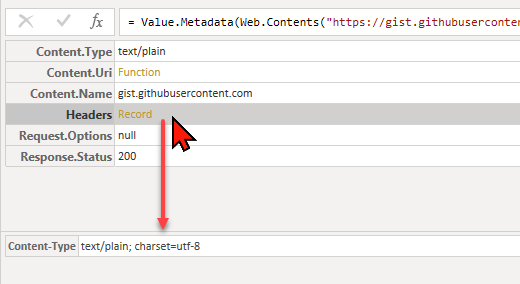
Many Power Query function not only return their values as advertised in their function documentation, but on top of that a metadata record. This record is like tag that holds additional information about the returned main value (for more details about this, please check out my friend Lars Schreiber’s article about it). Useful metadata for … Read more

Transform a query into a function in Power Query and Power BI

In my previous blogpost I’ve described a method how to extract a substring that follows a certain pattern from a string. In this post I show how to transform a query into a function that can be applied to many rows of a table.

Video how to transform a query into a function

Please check the video for detailed steps. In there I also show how to modify the code. It shall also detect strings with a sequence of just 8 numbers. In the original query, those had to be followed by a minus sign and another number:

Read more

Extract pattern string and numbers from text using List.Accumulate in Power Query

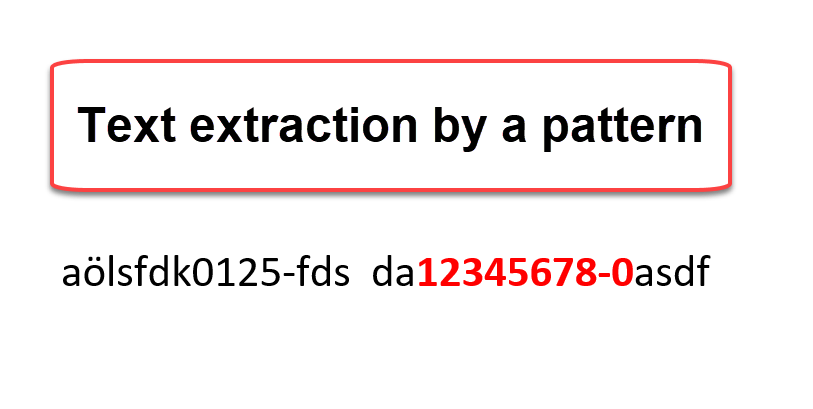
A typical task when cleaning data is to extract substrings from string that follow a certain pattern. In this post I’m going to describe a method that uses the List.Accumulate function for it. Extract a pattern string.

Task

I have to extract a payroll key from a description field that starts with 8 number, followed by an “-” and another number.

aölsfdk0125-fds  da12345678-0asdf

So I’m after the 12345678-0.

Plan

I plan to approach this by

Read more

Performance tip to speed up slow pivot operations in Power Query and Power BI

Pivot operations in are a very handy feature in  Power Query but they can slow down refresh performance. So with some bittersweet pleasure I can tell that I found a trick to speed them up. The sweetness comes from the fact that the performance improvement is very significant. But the bitterness comes from the fact that I could have used this for almost 4 years now, but was too blind to realize at the time when I first worked with the code.

Trick to speed up a slow pivot table

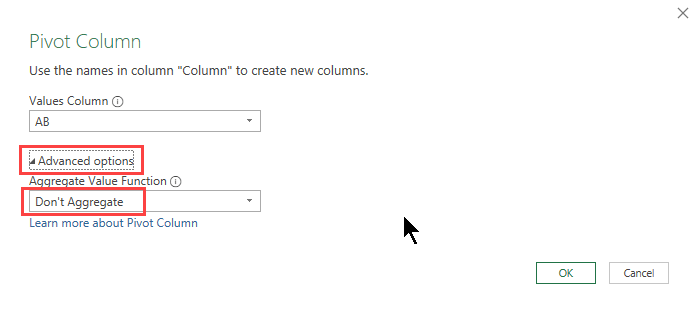
This might not work everywhere, but for my tests, it worked really well: Don’t use an aggregation function when you want fast pivoting:

slow pivot
Don’t aggregate when you want a fast pivot in Power Query

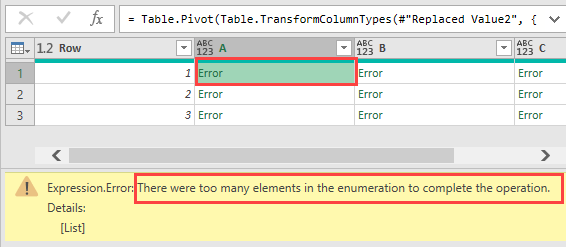
But if your data isn’t aggregated on the row- & column values already, you’ll get this error message:

Error when the values are not adequately aggregated

So to make this work, you have to aggregate the values on the axis’ values before.

Let’s walk through the steps:

Walkthrough

Read more